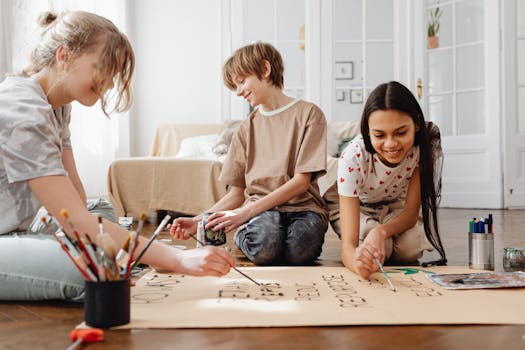

Ever tried to explain the Pythagorean theorem and watched a room full of blank stares? Or perhaps, you’ve led a team-building exercise that felt about as exciting as watching paint dry (pun intended, but more on that later). We’ve all been there, right? We grasp for ways to make learning stick, to transform dry facts into vibrant experiences. This is where the magic of integrating arts into experiential learning activities truly shines. It’s not about turning everyone into a Picasso, but about harnessing the power of creative expression to make learning resonate, ignite curiosity, and frankly, be a whole lot more fun.
Why Bother With Brushstrokes and Ballads?
Let’s be honest, sometimes the phrase “arts integration” can sound a bit… well, artsy. Like something you do in a Montessori preschool, not a serious professional development workshop or a high school science class. But here’s the secret sauce: the arts tap into different parts of our brains, the ones that process emotion, spatial reasoning, and even problem-solving in incredibly nuanced ways.
When we move beyond purely analytical or linear learning, we unlock deeper understanding. Think about it: how many times has a song’s melody or a movie’s scene stuck with you far longer than a textbook chapter? That’s the power of art – it creates an emotional connection, a sensory experience that anchors information. Integrating arts into experiential learning activities isn’t just a nice-to-have; it’s a potent tool for enhancing retention and comprehension.
Sculpting Understanding: Practical Ways to Integrate Art
So, how do we actually do this without making it feel forced or like a mandatory art class nobody signed up for? It’s about thoughtful application, weaving creative elements into existing or planned experiential activities.
#### From Passive Observation to Active Creation
Experiential learning is, by definition, about doing. But how can art amplify that “doing”?
Visual Storytelling: Instead of a written report on a historical event, ask participants to create a visual timeline, a storyboard for a documentary, or even a short comic strip depicting key moments. This forces them to synthesize information and think about narrative flow. In my experience, the “aha!” moments often come when people are translating complex ideas into visual metaphors.
Kinesthetic Expression: For abstract concepts like physics principles or economic models, consider body-based activities. Can students act out the movement of particles? Can they physically represent supply and demand curves through movement and positioning? This turns abstract theory into a tangible, memorable experience.
Musical Mnemonics: Ever tried to learn a language without a song? It’s tough! Encourage participants to create jingles or short songs to remember key facts, formulas, or processes. This taps into auditory memory and makes recall significantly easier.
#### The Power of the Palette in Problem-Solving
Many complex challenges require creative solutions. Integrating arts into experiential learning activities can foster this innovative mindset.
##### Designing Solutions, Not Just Stating Them
When faced with a problem, participants often jump to the most obvious, linear solution. Art encourages divergent thinking.
Prototyping with Play: For product development or process improvement, instead of just sketching, have teams build rough, artistic prototypes using clay, LEGOs, or even just cardboard and tape. The tactile nature of building encourages iterative design and reveals practical flaws or brilliant improvements that might be missed on paper.
Mind Mapping with Metaphor: Beyond traditional mind maps, encourage participants to use symbols, drawings, and color to represent ideas and connections. What does “collaboration” look like? Is it two interlocking gears, or a flock of birds flying in formation? This visual approach can uncover hidden relationships and spark new avenues of thought.
Beyond the “Wow” Factor: Deeper Learning Outcomes
It’s easy to get caught up in the novelty of arts integration. But the real value lies in the tangible learning outcomes it produces.
#### Boosting Engagement and Retention
Let’s face it, people learn best when they’re engaged. When learning involves active creation and sensory input, it naturally becomes more memorable.
Emotional Connection: Art has a unique ability to evoke emotions. When learners connect emotionally with the subject matter, whether through creating a piece of art that reflects their understanding or interpreting an existing artwork related to the topic, the learning becomes more personal and impactful.
Multi-Sensory Input: Integrating arts appeals to multiple senses. This multi-sensory approach reinforces learning by creating more neural pathways associated with the information. It’s like giving your brain multiple “save” buttons for the same data.
#### Cultivating Essential 21st-Century Skills
The skills fostered by arts integration are precisely those needed in today’s dynamic world.
Critical Thinking and Analysis: Interpreting art, or creating it with a specific goal, requires careful observation, analysis, and synthesis of information. Learners must deconstruct the elements, understand the intent, and evaluate their own creations.
Collaboration and Communication: Many art-based experiential activities are inherently collaborative. Working together to create a mural, a performance, or a constructed model teaches vital teamwork and communication skills. How do you negotiate creative differences when painting the same canvas? That’s a real-world lesson!
Avoiding the “Art Class” Trap: Authenticity is Key
One of the biggest pitfalls in integrating arts into experiential learning activities is making it feel like a tacked-on, obligatory segment. It needs to feel authentic to the learning objective.
#### Authenticity Over Artifice
Purposeful Integration: Every artistic element should serve a clear pedagogical purpose. Ask yourself: “How does this artistic activity help achieve the learning goal more effectively?” If it feels like busywork, it probably is.
Focus on Process, Not Perfection: Emphasize the learning journey and the creative process over producing a flawless masterpiece. The goal is understanding and exploration, not necessarily an award-winning art exhibition. It’s interesting to note that sometimes the most “imperfect” creations lead to the most profound insights.
Participant Choice and Voice: Whenever possible, offer choices in artistic medium or approach. Allowing learners agency in how they express their understanding can significantly boost engagement and ownership.
Wrapping Up: Unleash Your Inner Innovator (with a Paintbrush)
Integrating arts into experiential learning activities is more than just a creative garnish; it’s a fundamental shift towards more effective, engaging, and memorable learning. By tapping into our innate human capacity for creativity and expression, we can transform passive reception into active discovery. It’s about making learning not just informative, but transformative.
So, the next time you’re designing an experiential learning activity, don’t just think about the facts and figures. Ask yourself: How can I invite a bit of color, a touch of movement, or a dash of imaginative storytelling into this experience? And perhaps, most importantly, how can we make sure our learners leave not just with knowledge, but with a spark of inspiration that lasts?